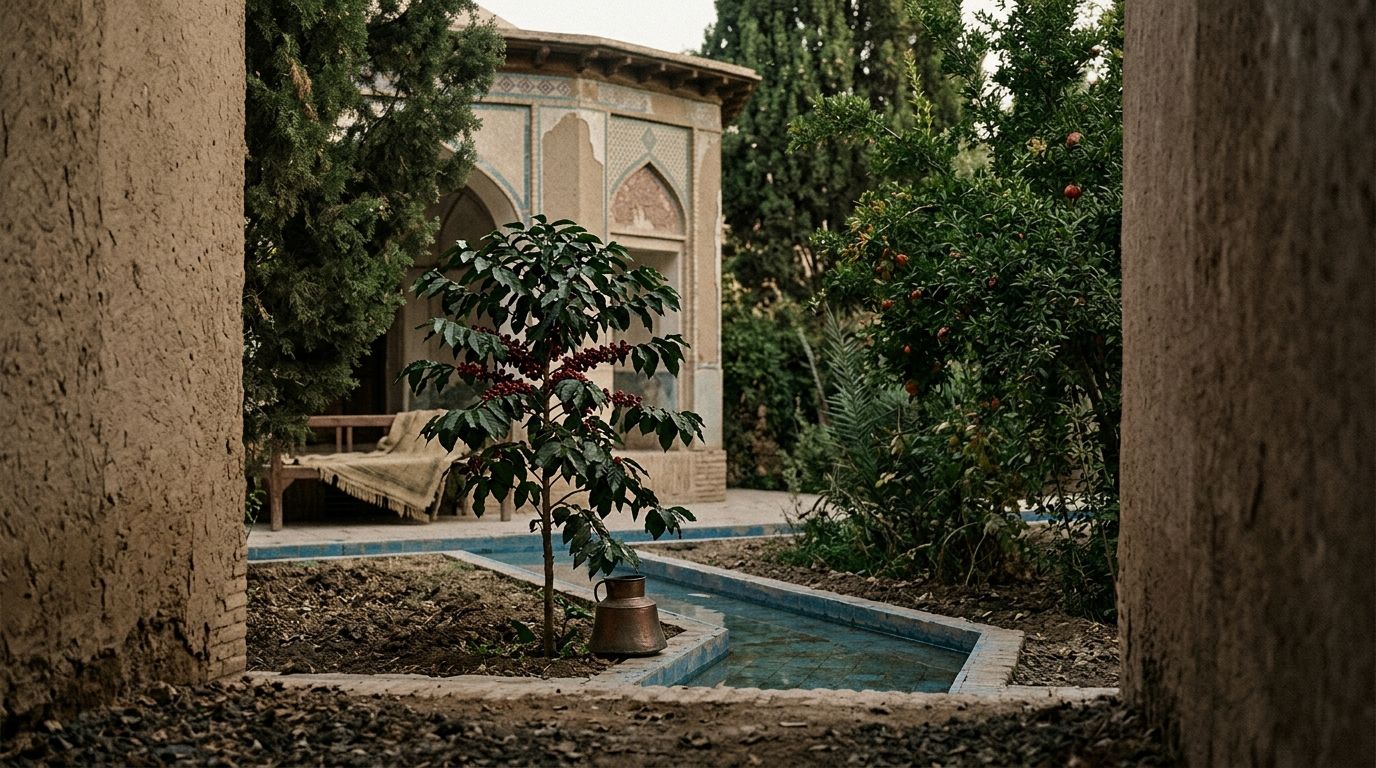








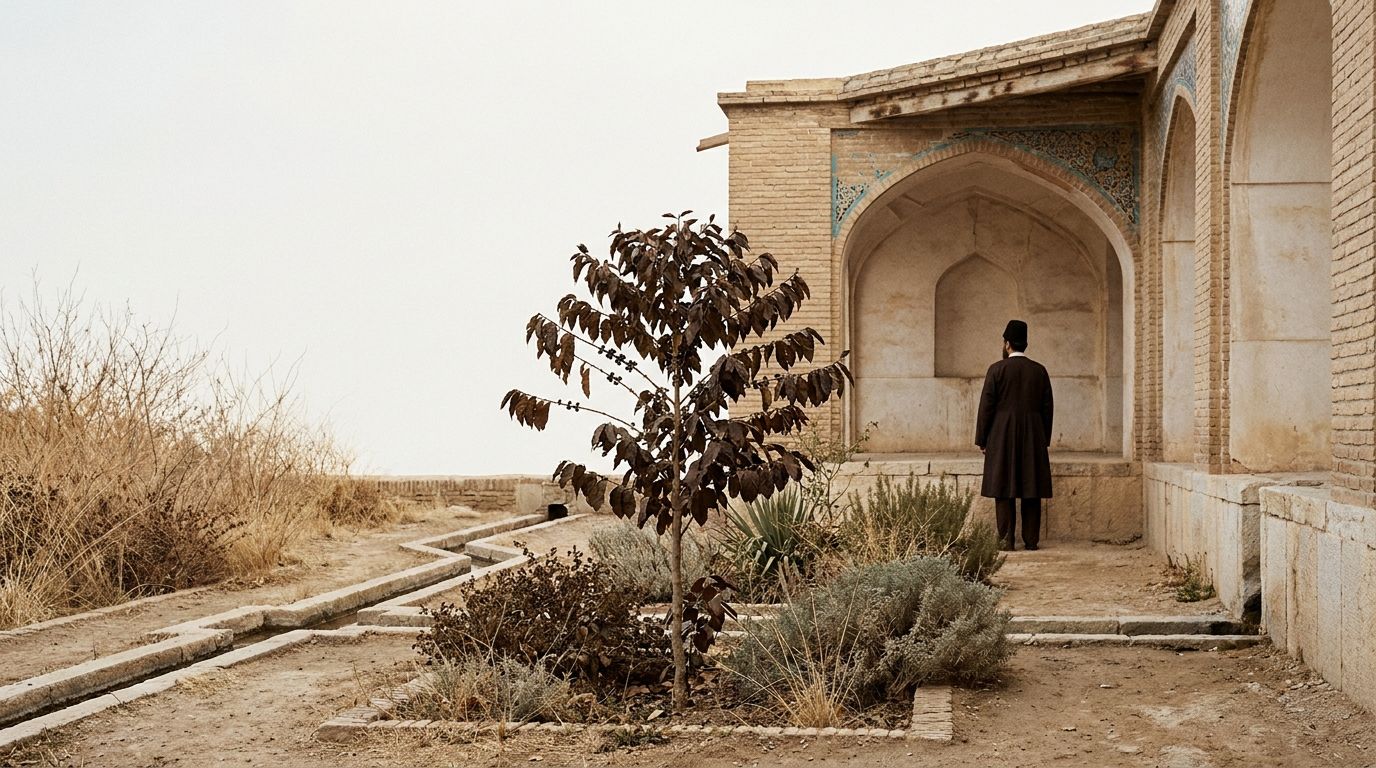
There is a specific kind of silence that settles over a landscape when an agricultural experiment fails. It is not the dramatic silence of a battlefield or a ruined city. It is the quiet, mundane silence of a garden returning to what it was always meant to be.
We have spent this series exploring the ghosts of Persian coffee—the wealthy Qajar princes, the bewildered cooks, the doomed trees freezing in the Tehran winter. But the most profound tragedy of these historical attempts is not that they failed. It is that they were completely, utterly forgotten.
The Architecture of Amnesia
History is written by the victors, but agricultural history is written by the harvest.
If a crop succeeds, it embeds itself into the culture. It changes the diet, the economy, and the language. When tomatoes and potatoes arrived in the Middle East from the Americas, they were adopted so deeply that it is now impossible to imagine Persian cuisine without them. They succeeded, and therefore, they are remembered.
When a crop fails—when the coffee trees wither in the alkaline soil and the frost—there is no monument built to commemorate the attempt. The dead wood is burned. The irrigation channels are redirected. Pomegranates or pears are planted in the empty soil, and within a single season, the physical evidence of the failure is erased.
Because the Qajar attempts to grow coffee yielded no fruit, they yielded no cultural footprint.
The Missing Archive
If you go to the national archives, you will find meticulous records of the silk trade, the taxation of wheat, and the imports of British tea. You will find very little regarding domestic coffee cultivation.
This absence of documentation is not an accident; it is a mechanism of aristocratic preservation. In a society where immense wealth and power were tied to the appearance of absolute control, a prince did not commission a scribe to record the humiliating death of his expensive, exotic garden. The failure was a private embarrassment, swallowed by the estate and hidden from the public record.
Without a harvest to sell, and without a written record to preserve the memory, the attempt to grow coffee in Persia evaporated.
The Resurgence of the Seed
It is deeply ironic that over a century later, Iran is experiencing a massive, explosive coffee renaissance.

The modern cafes of Tehran, Shiraz, and Isfahan are not serving domestic coffee—they are importing high-grade specialty beans from Ethiopia, Colombia, and Panama, armed with the scientific knowledge of extraction, water chemistry, and precision roasting that their ancestors lacked.
When a modern Iranian barista dials in a perfect shot of espresso, they are participating in a global culture. They are likely unaware that somewhere, beneath the concrete foundations of the city, or buried in the ash of a 19th-century garden bonfire, lies the ghost of an ancestor who tried to do exactly what they are doing: master the seed.
They tried. They failed. And we forgot.
But the desire for the dark, complex elixir never truly left the culture. It simply went dormant, waiting for the right century to wake up.
Historical Reality
The concept of “agricultural amnesia” is a recognized phenomenon in environmental history. Crops that fail to adapt to local climates are rarely recorded in long-term historical narratives unless they cause massive economic collapse. The modern specialty coffee boom in Iran (the “Third Wave”) is a documented, contemporary cultural shift, representing a return to coffee consumption, though entirely reliant on modern global supply chains rather than domestic cultivation.
The QHVE Question
If failure is immediately erased from our cultural memory, how many times is a society doomed to attempt the exact same impossible experiment?
Sources:
- Matthee, Rudi. The Pursuit of Pleasure.
- Floor, Willem. Agriculture in Qajar Iran.
- Contemporary sociological studies on the rise of café culture in modern Iran.
SEO & Meta
SEO Title: The Forgotten History of Coffee in Iran | Agricultural Amnesia
Meta Description: A cultural essay exploring why the historical failures to grow coffee in Persia were completely erased from cultural memory, and the irony of Iran’s modern coffee boom.
URL Slug: once-someone-tried-to-grow-coffee-here
Tags: Cultural Memory, Sociology, History, Qajar Era, Coffee Culture
Primary Search Intent: Informational / Essay
Related Search Queries: modern cafe culture in Iran, agricultural history of the Middle East, why do we forget history, specialty coffee in Tehran.
Social Version
Instagram / X Hook: History is written by the victors, but agricultural history is written by the harvest. When the 19th-century Persian attempts to grow coffee failed against the harsh climate, the dead trees were burned and replaced with pomegranates. Because there was no harvest, there was no record. The failure was completely erased from cultural memory. Today, as specialty coffee booms across Iran, modern baristas are unknowingly echoing the forgotten ghosts of their ancestors. Read the final essay at QHVE.
Short-form Video Concept:
- 0:00 - 0:05: Fast time-lapse of a modern, sleek espresso machine pulling a shot. (Voiceover: “Iran is currently experiencing a massive coffee boom.”)
- 0:05 - 0:15: Cut to a vintage photo of an empty, arid landscape. (Voiceover: “But what most people don’t know is that over a century ago, they tried to grow it themselves. And failed.”)
- 0:15 - 0:25: Visual of a ledger book closing and fading to black. (Voiceover: “When agriculture fails, we don’t build monuments. We erase it. The dead trees were burned. The records were never written.”)
- 0:25 - 0:35: Back to the modern cafe. (Voiceover: “The desire for coffee never left the culture. It just went to sleep for a hundred years. Read the final essay at QHVE.”)