





Cities devour their own history. As the Qajar dynasty fell and the Pahlavi era ushered in a brutal, concrete modernization in the 1920s, the vast, walled Chahar Bagh gardens of the old aristocracy were the first casualties.
The high mud-brick walls that had once protected pomegranates, persimmons, and the occasional doomed exotic experiment were bulldozed to make way for wide avenues and geometric apartment blocks. The ancient qanat irrigation channels were capped or filled with rubble.
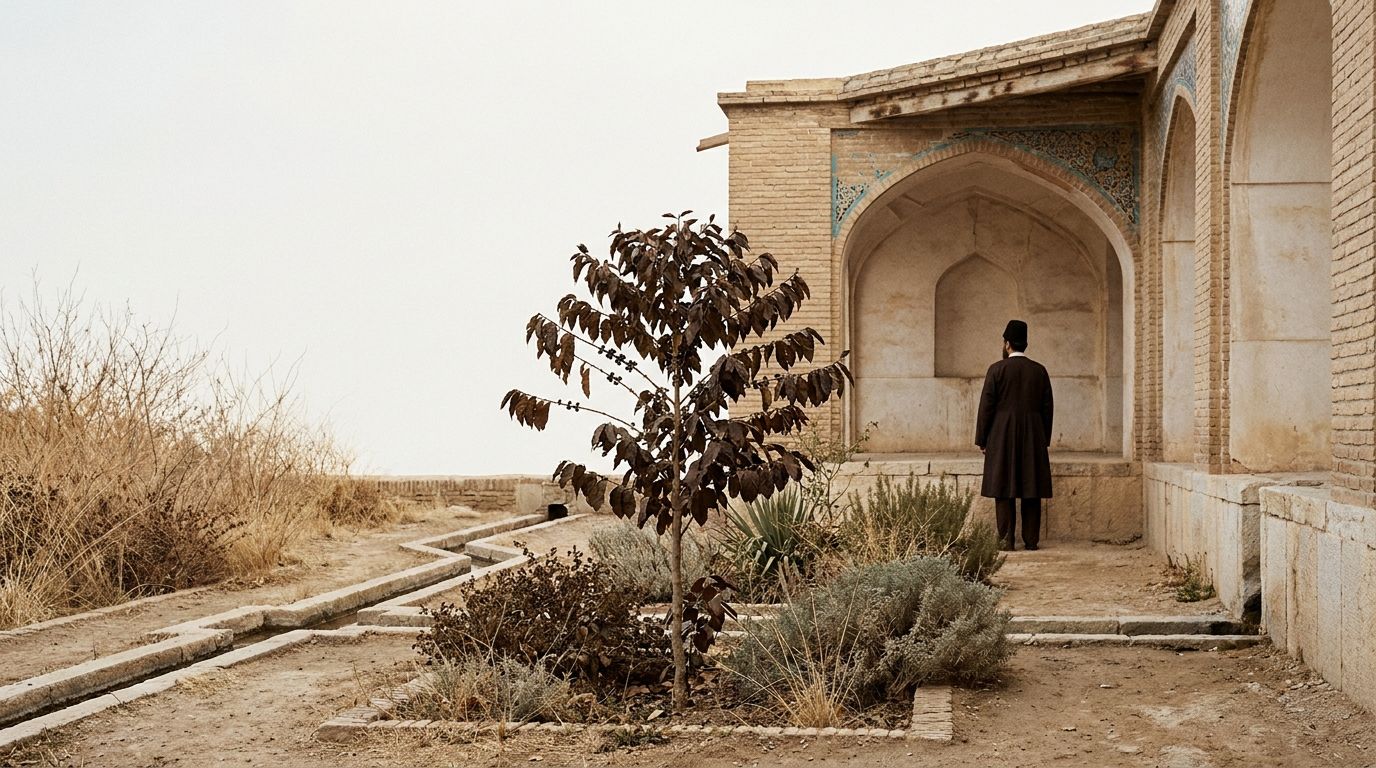
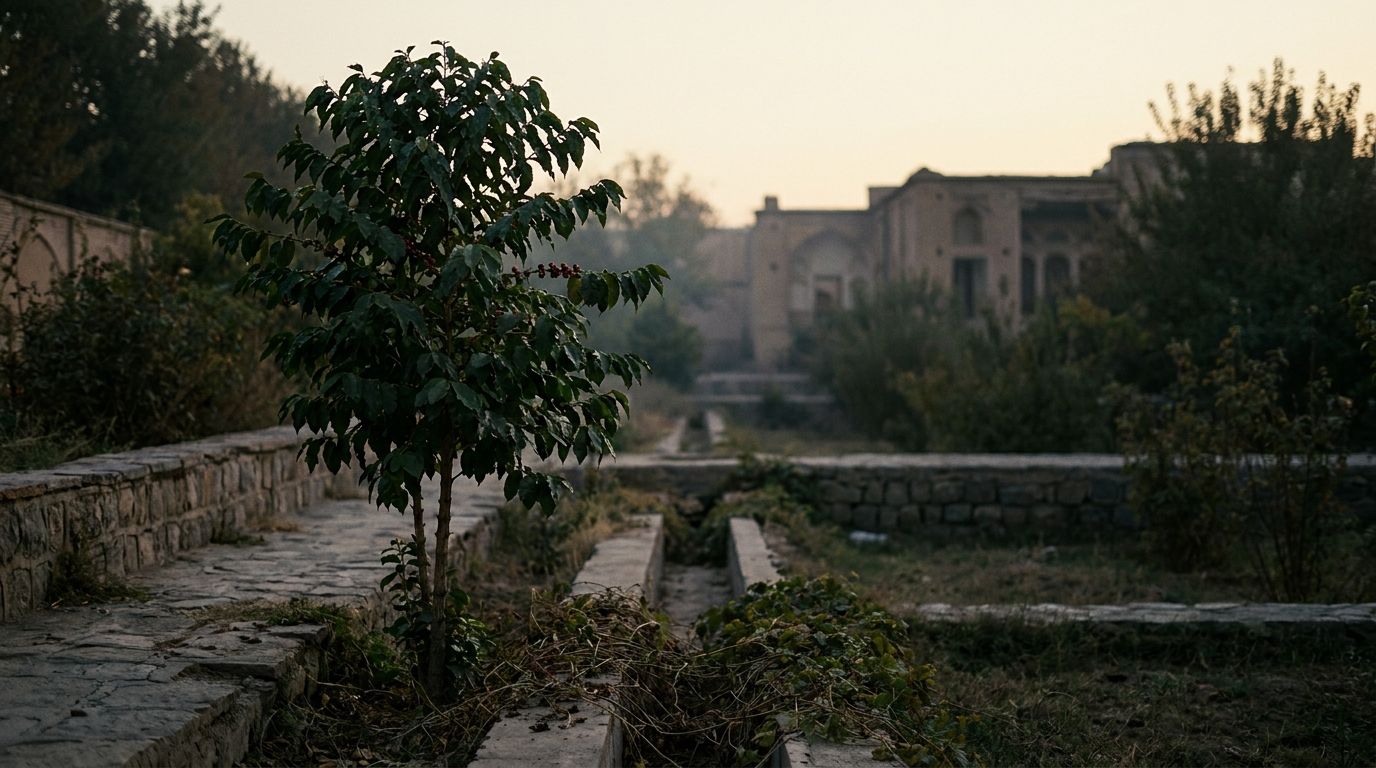
In the corner of one such ruined estate, hidden behind a collapsed bathhouse and choking on dust, a single shrub refused to die.
The Sterile Survivor
It was not a native plant. Its leaves, though crusted with the exhaust of early automobiles and scorched by decades of unmitigated summer sun, were thick, glossy, and distinctly tropical.
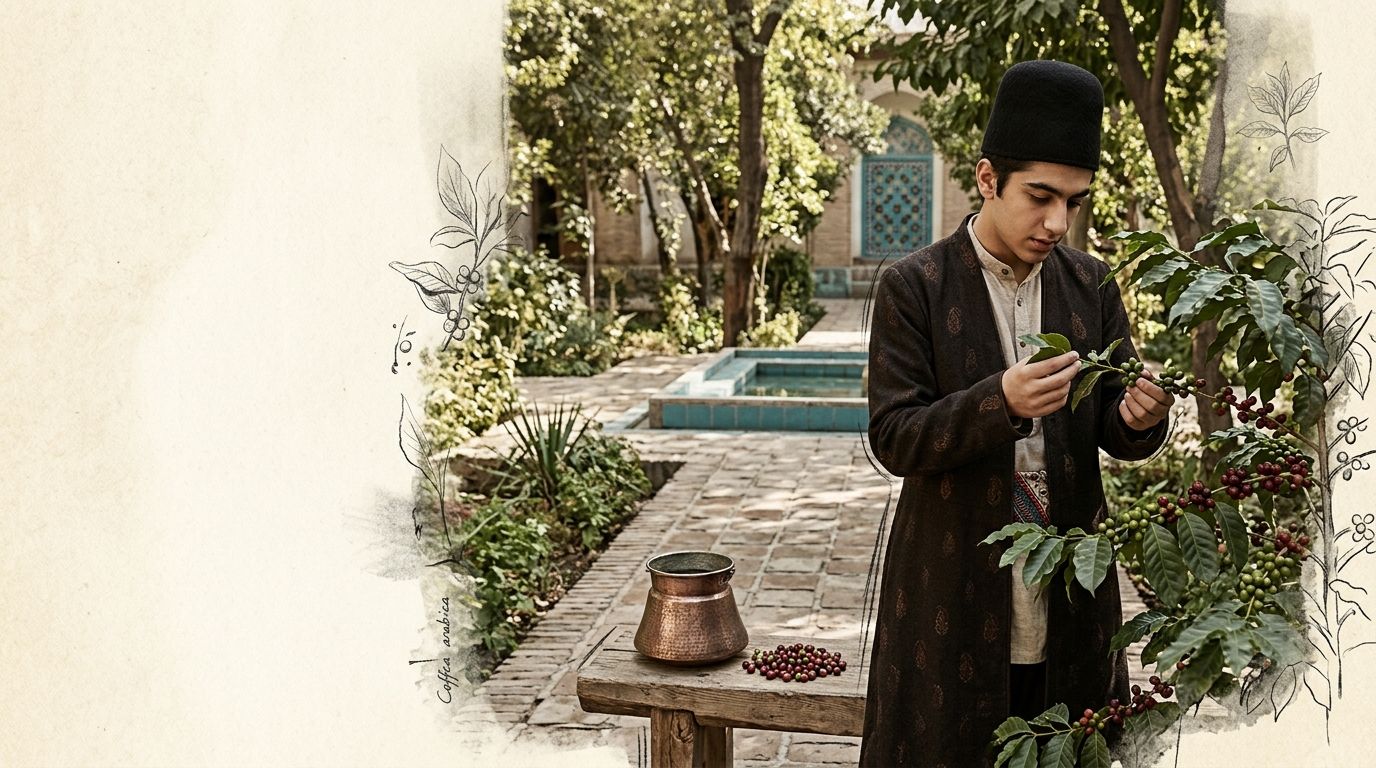
It was a Coffea arabica tree—the sole survivor of an aristocratic obsession that had failed half a century earlier.
How it survived the harsh Tehran winters is a botanical mystery. Perhaps the collapsed wall of the bathhouse provided just enough thermal mass to stave off the killing frosts. Perhaps its root system had managed to tap into a leaking, forgotten water pipe deep beneath the rubble.
But survival is not the same as thriving. The tree was sterile. Without the proper soil acidity or humidity, it had never produced a single blossom, let alone a cherry. It existed in a state of suspended animation—a living ghost of a forgotten ambition.
The Encounter
The story goes that in the late autumn of 1928, a team of laborers was clearing the back lot of the estate to lay the foundation for a new municipal building.
The foreman, a man who had grown up in the agricultural villages of the north, ordered his men to cut down the thick tangle of weeds and dying persimmon trees. When they reached the dark, glossy shrub huddled against the brickwork, the men hesitated. The wood was incredibly hard, snapping the blades of their cheap iron axes.
The foreman approached the shrub. He rubbed one of the leathery leaves between his fingers. He had never seen anything like it. It wasn’t fruitwood. It wasn’t a local ornamental.
“What is it?” one of the laborers asked.
The foreman shook his head. “A weed,” he finally said. “A stubborn weed. Bring the heavy picks. Dig out the roots.”

The Erasure
It took three men an hour to pry the root ball from the dry, alkaline earth. The root system was massive, gnarled, and desperate, having spent fifty years fighting the soil just to keep the sterile branches alive above ground.
When the tree was finally pulled free, it was dragged to the center of the lot and thrown onto a massive bonfire of broken beams, dead vines, and refuse.
As the flames consumed the hard, dense wood of the coffee tree, the air did not smell of roasting coffee. It smelled only of burning, anonymous brush. The laborers sat around the fire, drinking strong, hot black tea from small glass cups, entirely unaware that they had just incinerated the last physical evidence of Persia’s attempt to grow coffee.
Historical Reality
The destruction of Qajar-era gardens during the modernization of Tehran is a well-documented historical tragedy, resulting in the loss of immense cultural and botanical heritage. While the survival of a single coffee tree is highly improbable due to the climate, the narrative captures the reality of how rapidly urban expansion erases agricultural history. The transition of the laborers drinking tea around the fire reflects the complete cultural shift that had occurred by the 1920s.
The QHVE Question
When a city modernizes, it doesn’t just pave over buildings; it paves over the biological memory of the soil. What else lies forgotten beneath the concrete?
Sources:
- Grigor, Talinn. Building Iran: Modernism, Architecture, and National Heritage under the Pahlavi Monarchs.
- Madanipour, Ali. Tehran: The Making of a Metropolis.
SEO & Meta
SEO Title: The Lost Gardens of Tehran | Qajar Architecture & History
Meta Description: A literary reconstruction of the rapid modernization of Tehran in the 1920s, and the destruction of the historic Qajar-era walled gardens and their botanical secrets.
URL Slug: last-coffee-tree-princes-garden
Tags: History, Urban Decay, Persian Gardens, Architecture, Qajar Era
Primary Search Intent: Informational / Storytelling
Related Search Queries: Tehran modernization history, Qajar gardens destroyed, history of Chahar Bagh, old Tehran architecture.
Social Version
Instagram / X Hook: Cities devour their own history. In the 1920s, the rapid, concrete modernization of Tehran bulldozed the ancient, walled gardens of the Qajar aristocracy. Hidden in the rubble of one estate was a botanical ghost: a single, sterile coffee tree that had stubbornly survived for fifty years. Read the story of its discovery, and its ultimate erasure by a crew of tea-drinking laborers, at QHVE.
Short-form Video Concept:
- 0:00 - 0:05: Archival footage or photos of 1920s Tehran construction. (Voiceover: “When a city modernizes, it destroys its biological memory.”)
- 0:05 - 0:15: Visual of a crumbling brick wall with a tough, green plant surviving in the dust. (Voiceover: “In the ruins of a Qajar garden, laborers found a shrub that refused to die. It was a coffee tree.”)
- 0:15 - 0:25: Sounds of heavy picks hitting dry earth. (Voiceover: “It had survived fifty freezing winters. But it had never produced a single bean.”)
- 0:25 - 0:35: Slow-motion fire. A glass of black tea. (Voiceover: “They called it a weed. They burned it. And while it burned, they drank tea. Read the full story at QHVE.”)